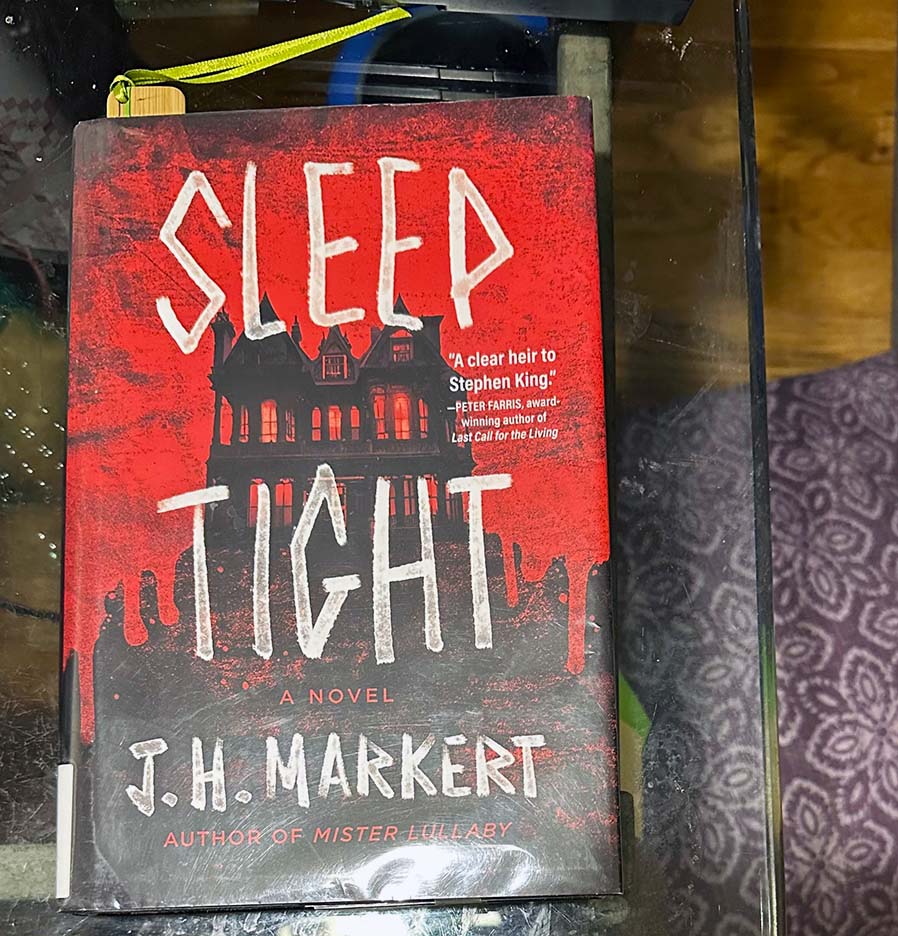
I read more than half of “Sleep Tight,” a novel by J.H. Markert, before bailing on it.
In fairness, I hadn’t chosen it for myself. It was one of the selections in the Lit Crate that my library packed for me.
“With captivating prose and an old-school horror flair, ‘Sleep Tight’ is a must-read, haunting tale from a true master of the genre,” according to the dust jacket.
I wonder what genre that is supposed to be. This is partly because of the cover blurb: “A clear heir to Stephen King.” – Peter Farris, award-winning-author of “Last Call for the Living”
More on this in a moment.
For the Lit Crate, we were told to choose three to five genres. Mine were dystopian, horror and supernatural creatures. Thriller/suspense and crime were options I did not select, but I think this book would have fallen under one of those genres.
I began reading this book thinking it would be a thriller, and I was OK with that. I also was predisposed to grant the author some grace for sense of place. He’s from Louisville, and I grew up 30 miles down the road. He pulls the tale from Montana back to Kentucky, talking about the pervasive smell of the “angel’s share” of bourbon evaporating.
The book begins with a section labeled “Before.” There are other sorts of flashbacks, such as police interviews, and these are clearly labeled as well. And the action kicks off quickly and keeps spinning off new events. Everything is easy to follow.
This is not to say that it all makes sense. The protagonists’ child is abducted, but doesn’t fit the pattern of other abductees. The Outcast might make the pieces fit, but only if he magically knows Tess was going to call a divorce lawyer.
Back to that dust jacket. This was not captivating prose. This was self-aware, author-intrusive prose. I don’t know how it’s horror other than that the antagonist kills people. And I find Stephen King masterful at stepping back and letting readers immerse themselves in his story; I never was able to do that in this book.
The references to the holes in Tess’ memory grew tiresome. Her husband Justin’s judgment, much more so. Hints of abuse in Tess’ past are in conflict with what we’ve been told about her childhood (granted, I didn’t finish the book, so maybe that gets resolved). And when Justin diagnoses Noah with dissociative identity disorder, it has been telegraphed so long – from page 3 of the novel – there is no way to be surprised.
When I realized that reading this novel had become a chore I wasn’t looking forward to, I asked the critical question: Do I care what happens to these people? To Tess, to her police partner Danny, to friend Eliza, to the kidnapped Julia? Nope. Mildly curious about Noah, but not enough to suffer through another 149 pages.

 Beth's Planet
Leave a comment